One job, six tools, measured
We built the same job in six tools, the way a normal user of each would, with default settings, and ran it five times on the same machine. All six produced the same 144 rows. Where another tool wins, the page says so.
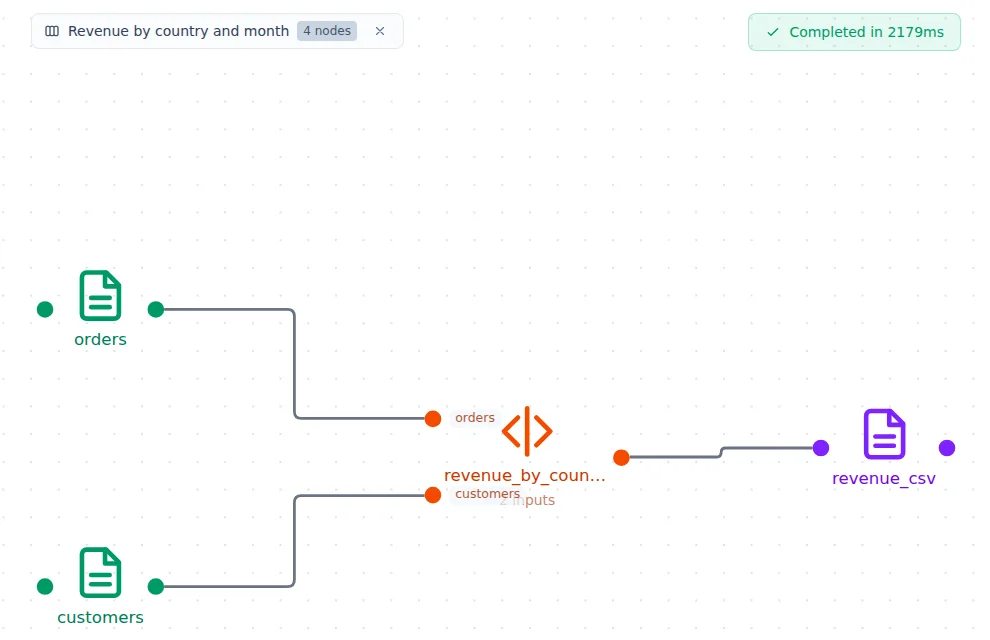
The job: Read 5,000,000 orders and 200,000 customers from CSV, keep the paid orders, look up each customer’s country, group by country and month (count and sum of the amount), sort, and write the 144 result rows to CSV.
Median of 5 runs. Not all numbers measure exactly the same thing: Odara and NiFi run on a server that is already started; Talend, Hop and dbt include the start of their runtime; KNIME is timed in its desktop application. Each card says what was measured.
What the numbers say
- Odara was the fastest of the visual tools: 2.0 s, with one native binary and no JVM.
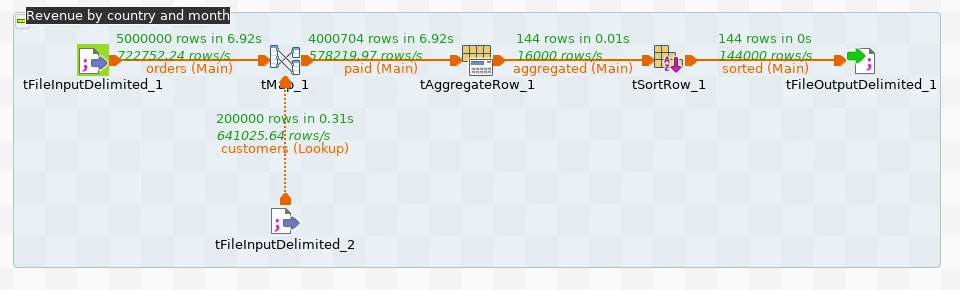
- Talend Open Studio 8 came close at 4.5 s, its JVM start included: its generated Java is efficient. It no longer gets updates or security fixes.
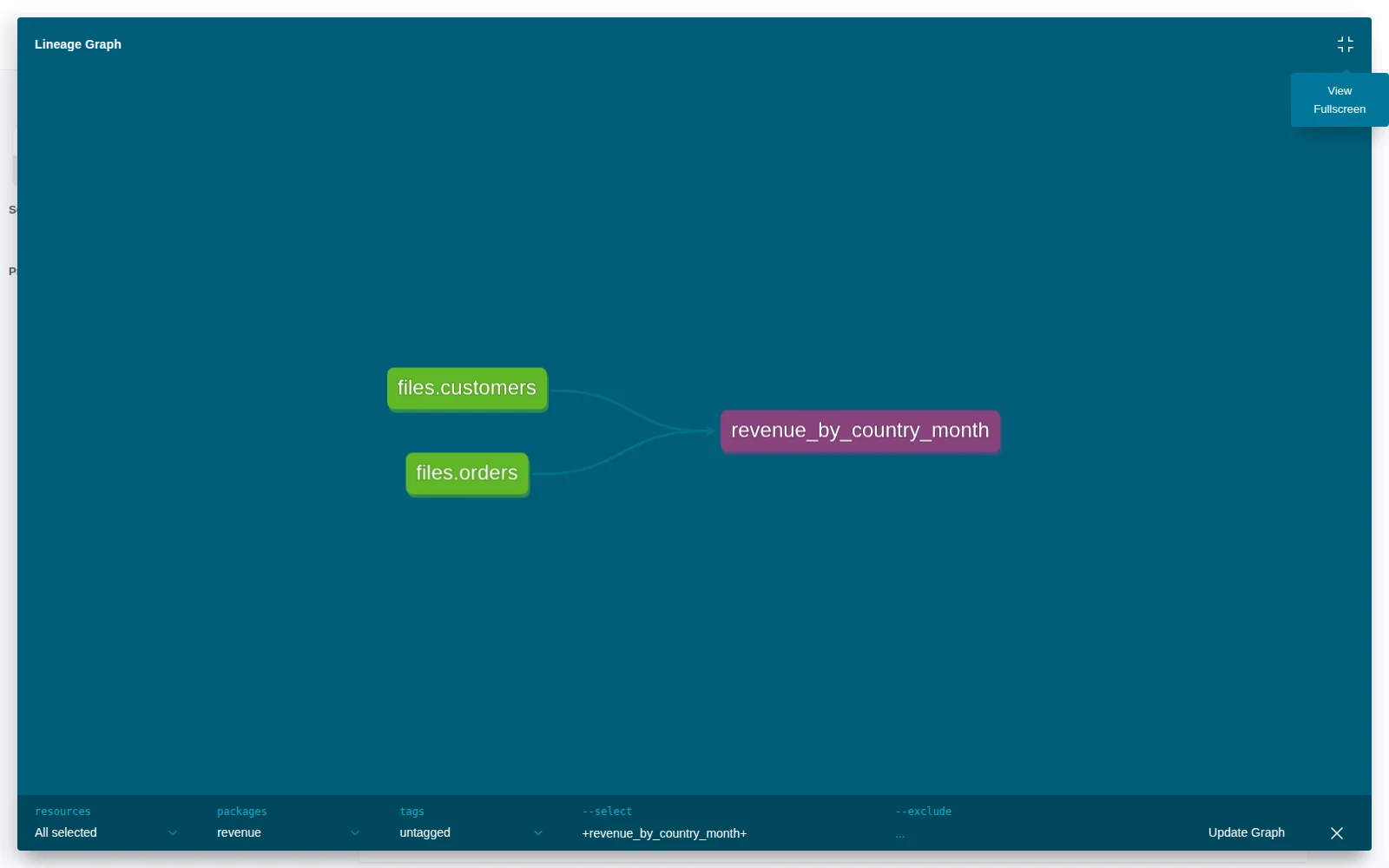
- dbt with DuckDB has the fastest engine: about 0.6 s for the query itself, 3.0 s with dbt’s start-up. It has no visual editor and only transforms data.
- KNIME (26.8 s), NiFi (35.5 s) and Apache Hop (39.9 s) were much slower on this job with default settings. Each card says where the time went.
Odara and Talend Open Studio
Full comparison: Odara and Talend Open Studio
Odara ETL 0.4.4
2.0 s median of 5 runs
- Measured
- Run on a running Odara server, through the API (server start: 2.3 s, not included)
- Memory
- 0.44 GB (whole server process)
- Download
- 139 MB
- Needs
- Nothing (no JVM)
- Licence
- Proprietary, free for any use, continuity pledge
Talend Open Studio 8.0.1 (the last free release)
4.5 s median of 5 runs
- Measured
- Standalone job built in the Studio (Build Job), run with Java 11; includes JVM start
- Memory
- 0.26 GB (job JVM, default -Xmx1024M)
- Download
- 831 MB, plus a Java runtime
- Needs
- Java 11 (Studio and jobs)
- Licence
- Apache 2.0; retired by Qlik on 31 January 2024
- Talend’s generated Java is fast: 4.5 s including the JVM start, the closest result to Odara among the visual tools.
- Open Studio has no command-line build: each job is built from the Studio. The first start also asks to download 48 required libraries.
- No more updates or security fixes since January 2024.
Choose Talend Open Studio if
- your jobs already run well and you can live without updates or security fixes
Odara and Apache Hop
Full comparison: Odara and Apache Hop
Odara ETL 0.4.4
2.0 s median of 5 runs
- Measured
- Run on a running Odara server, through the API (server start: 2.3 s, not included)
- Memory
- 0.44 GB (whole server process)
- Download
- 139 MB
- Needs
- Nothing (no JVM)
- Licence
- Proprietary, free for any use, continuity pledge
Apache Hop 2.9.0
39.9 s median of 5 runs
- Measured
- hop-run with the local engine, Java 17; includes JVM start (the pipeline itself: 36.5 s)
- Memory
- 0.68 GB
- Download
- 883 MB, plus a Java runtime
- Needs
- Java 17
- Licence
- Apache 2.0, open source
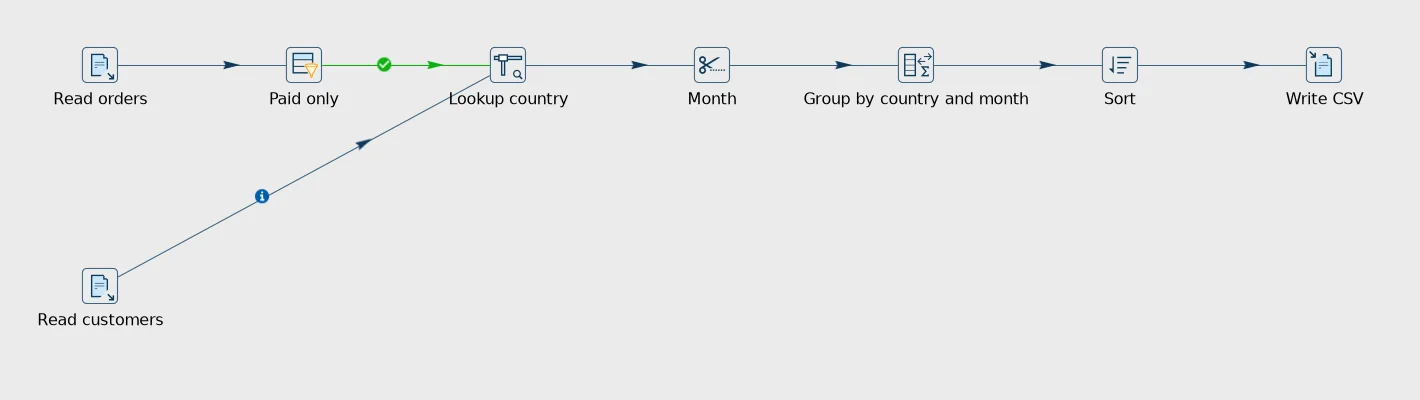
- Built with standard transforms and default settings. The Filter rows transform took about 32 of the 36.5 s: reading the 5 million rows alone took 2.3 s.
- We did not find a setting that changed it (lazy conversion off, a non-compressed lookup). If you know a faster way to build this pipeline in Hop, send it to [email protected] and we will publish the new number.
Choose Apache Hop if
- an open-source licence is a requirement today
- you need macOS or ARM64, or Apache Beam (Spark, Flink, Dataflow)
- your team knows Kettle / Pentaho
Odara and KNIME Analytics Platform
Full comparison: Odara and KNIME Analytics Platform
Odara ETL 0.4.4
2.0 s median of 5 runs
- Measured
- Run on a running Odara server, through the API (server start: 2.3 s, not included)
- Memory
- 0.44 GB (whole server process)
- Download
- 139 MB
- Needs
- Nothing (no JVM)
- Licence
- Proprietary, free for any use, continuity pledge
KNIME Analytics Platform 5.12.0
26.8 s median of 5 runs
- Measured
- Execute all in the desktop application (the free version has no headless run since 5.9)
- Memory
- Not comparable (desktop application, about 10 GB in total)
- Download
- 849 MB (Java included)
- Needs
- Its bundled Java 21
- Licence
- GPL v3 with extra permissions, open source
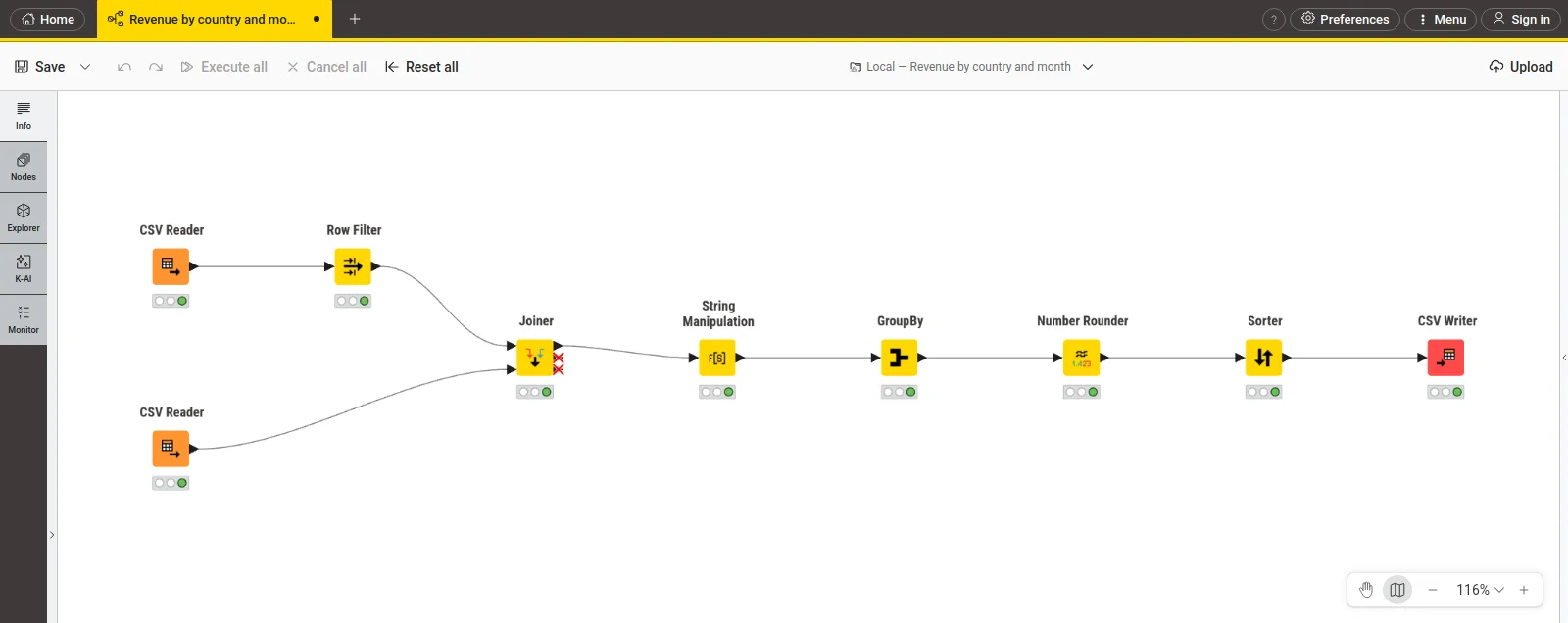
- Slowest steps: GroupBy 8 s, CSV Reader 6 s, Joiner and String Manipulation 5–6 s each.
- Running workflows from the command line or on a schedule now needs a paid KNIME product (KNIME forum, April 2026).
Choose KNIME Analytics Platform if
- you do analytics and data science as much as ETL
- you want the largest catalogue of nodes and a big community
- you need macOS
Odara and Apache NiFi
Full comparison: Odara and Apache NiFi
Odara ETL 0.4.4
2.0 s median of 5 runs
- Measured
- Run on a running Odara server, through the API (server start: 2.3 s, not included)
- Memory
- 0.44 GB (whole server process)
- Download
- 139 MB
- Needs
- Nothing (no JVM)
- Licence
- Proprietary, free for any use, continuity pledge
Apache NiFi 2.12.0
35.5 s median of 5 runs
- Measured
- Flow already running on a NiFi server, from the file landing to the result written (server start: 16 s)
- Memory
- 1.66 GB (server, default 1 GB heap)
- Download
- 847 MB, plus a Java runtime
- Needs
- Java 21
- Licence
- Apache 2.0, open source
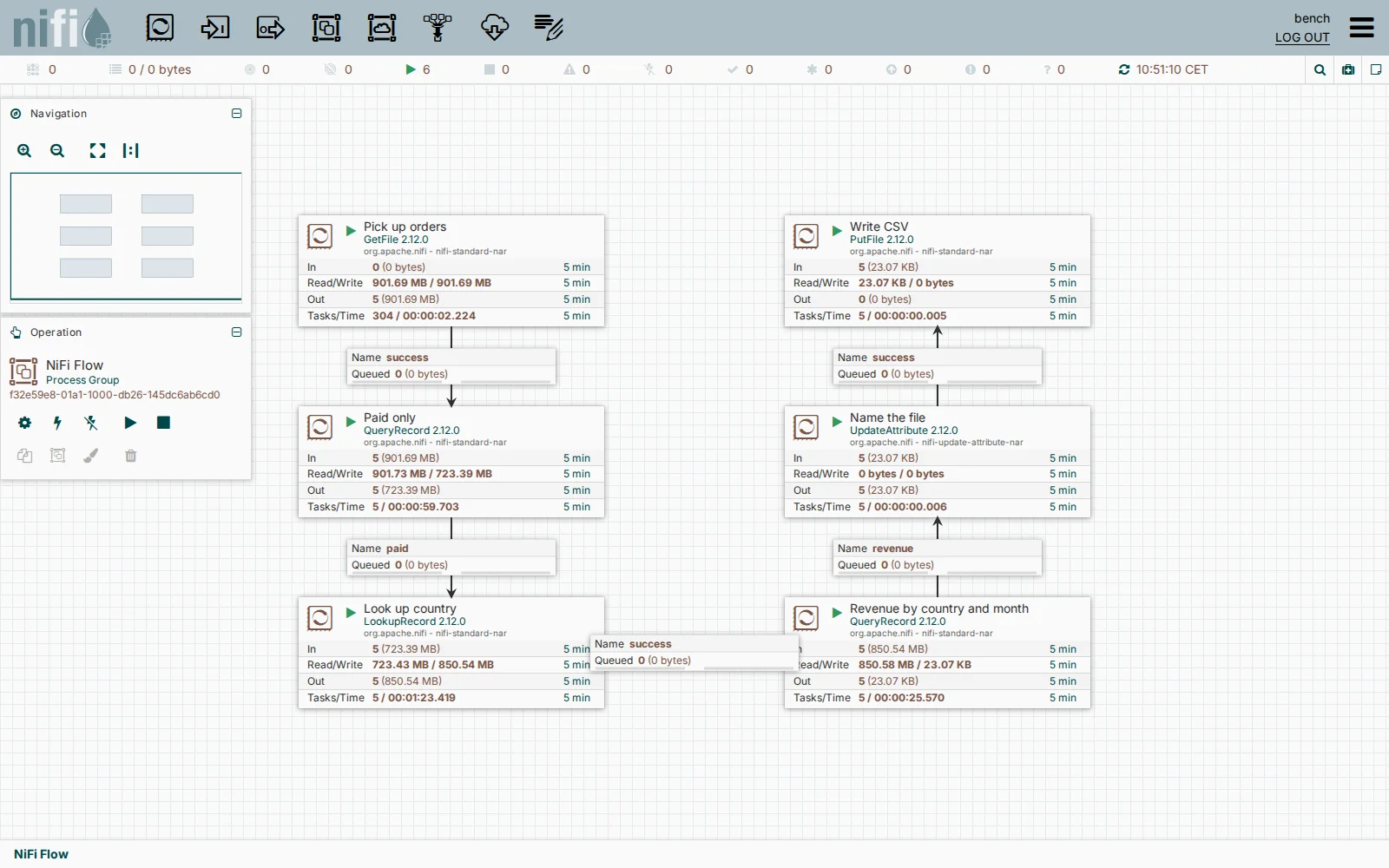
- NiFi moves and routes data continuously; a batch join and aggregation is not what it is built for. Each step reads and writes the whole file again.
- Default settings, no parallel tasks or file splitting.
Choose Apache NiFi if
- you move data continuously from many sources and need back-pressure, guaranteed delivery and a record of where every record went
Odara and dbt Core + DuckDB
Full comparison: Odara and dbt Core + DuckDB
Odara ETL 0.4.4
2.0 s median of 5 runs
- Measured
- Run on a running Odara server, through the API (server start: 2.3 s, not included)
- Memory
- 0.44 GB (whole server process)
- Download
- 139 MB
- Needs
- Nothing (no JVM)
- Licence
- Proprietary, free for any use, continuity pledge
dbt Core + DuckDB dbt-core 1.12.7, dbt-duckdb 1.11.1, DuckDB 2.0.0
3.0 s median of 5 runs
- Measured
- dbt run, end to end; includes about 2 s of dbt start-up (the query itself: about 0.6 s)
- Memory
- 0.46 GB
- Download
- 391 MB (Python virtual environment)
- Needs
- Python
- Licence
- Apache 2.0 (dbt) and MIT (DuckDB), open source
- DuckDB’s engine is the fastest in this test: the query takes about 0.6 s, against about 2 s for Odara’s run.
- dbt only transforms: no connectors to move data between systems, no visual editor, and no scheduler in dbt Core (dbt Cloud is paid).
Choose dbt Core + DuckDB if
- your data is already in one warehouse or database and your team works in SQL and Git
Method
- Machine: AMD Ryzen 5 3600 (6 cores, 12 threads), 62 GB RAM, NVMe disk, Linux 7.0. One tool at a time: a lock made sure no two timed runs overlapped.
- Data: synthetic, generated with a fixed seed: 5,000,000 orders (189 MB) and 200,000 customers (6 MB).
- Runs: five per tool, median reported; memory is the peak resident size of the process.
- Builds: standard components and default settings, as a normal user would build it. No tuning for any tool, including Odara.
- Downloads: official sources with checksums where published. Talend Open Studio 8.0.1 is no longer offered by Qlik; we used the archived copy of the official file (TOS_DI-20211109_1610-V8.0.1.zip) on archive.org.
- Not tested: Pentaho Data Integration (its free download needs a registration we did not do), and paid products (Informatica, Matillion, SSIS, Fivetran).
Repeat it yourself. The data generator and the job in each tool:
- generate_data.py: Generates the two CSV files (fixed seed: everyone gets the same data)
- odara-revenue-by-country-month.json: The Odara pipeline
- talend-Revenue_0.1.item: The Talend job (import into Open Studio)
- revenue-by-country-month.hpl: The Apache Hop pipeline
- knime-revenue.knwf: The KNIME workflow
- dbt-revenue_by_country_month.sql: The dbt model
The NiFi flow was built through its REST API with GetFile, QueryRecord, LookupRecord (SimpleCsvFileLookupService), QueryRecord, UpdateAttribute and PutFile. Paths in the files point to our test folder: change them to yours.
Found a faster way to build the job in one of these tools, or a mistake? Write to [email protected] and we will run it and publish the new number.